
Les Dialogues byzantins

Pendant la crise sanitaire du Covid-19, l’AEMB a instauré une série de visioconférences  pour continuer les dialogues entre les jeunes byzantinistes à distance : Les Dialogues byzantins de l’AEMB.

Les  Dialogues aspiraient à partager les travaux récents dans diverses disciplines, de la philologie à l’histoire de l’art et l’archéologie, dans le monde byzantin entendu au sens large. Ils visaient également à maintenir le contact avec des chercheurs et chercheuses formés en France, que leur parcours a conduits, pour certains, à poursuivre leur carrière dans des institutions étrangères.
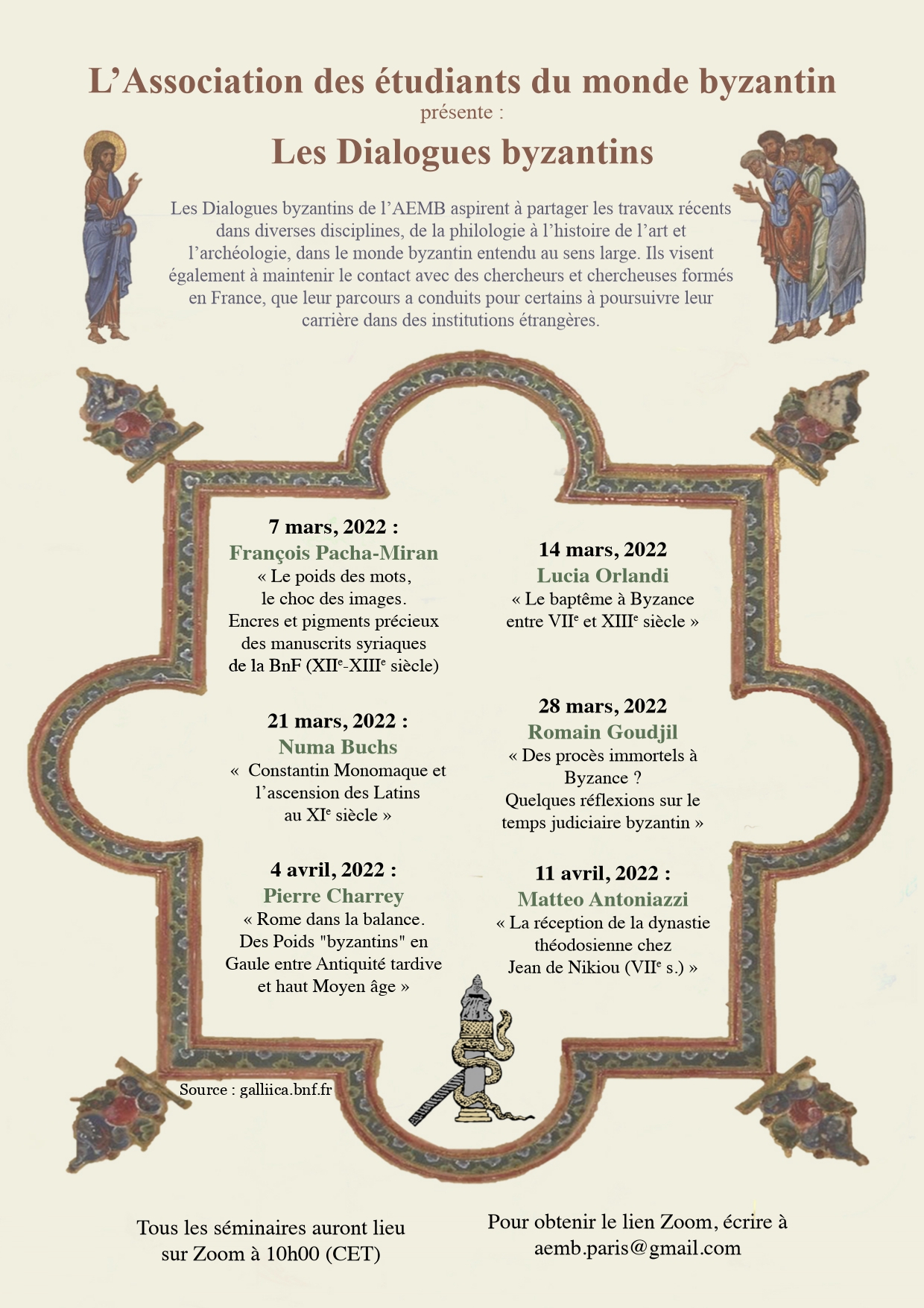
Les Dialogues de 2022

– Lundi 7 mars, 10h00, François Pacha-Miran, Docteur en histoire et l’art et archéologie : « Le poids des mots, le choc des images. Encres et pigments précieux des manuscrits syriaques de la BnF (XIIe-XIIIe siècle) »

– Lundi 14 mars, 10h00, Lucia Orlandi, Docteur en archéologie : « Le baptême à Byzance entre les VIIe et XIIIe siècles »

– Lundi 21 mars, 10h00, Numa Buchs, Docteur en histoire : « Constantin Monomaque et l’ascension des Latins au XIe siècle »

– Lundi 28 mars, 10h00, Romain Goudjil, Docteur en histoire : « Des procès immortels à Byzance ? Quelques réflexions sur le temps judiciaire byzantin »

– Lundi 4 avril, 10h00, Pierre Charrey, Docteur en histoire de l’art et archéologie : « Rome dans la balance. Gaule entre Antiquité tardive et haut Moyen âge »

– Lundi 11 avril, 10h00, Matteo Antoniazzi, Docteur en histoire : « La réception de la dynastie théodosienne chez Jean de Nikiou (VIIe siècle) »


Les Dialogues de 2021 

Cliquer ici pour télécharger l’annonce.

– Lundi 22 mars, 10h00, Geoffrey Meyer-Fernandez, Docteur en histoire et l’art et archéologie : « Recherches postdoctorales entre Chypre, la Crète et Rhodes à la fin du Moyen Âge »

– Lundi 19 avril, 10h00, Pietro d’Agostino, Docteur en philologie : « La littérature chrétienne en terre d’Islam : la figure de Théodore Abū Qurra entre Byzance et les Abbasides »

– Lundi 10 mai, 10h00, Milan Vukašinović, Docteur en histoire : « Moi au pluriel : Autobiographies byzantines du XIIIe siècle »

– Lundi 17 mai, 10h00, Véronique Petiteau, Docteur en histoire de l’art et archéologie : « La sacralisation du pouvoir en Serbie médiévale. Territoire, architecture et image (fin du XIIe siècle – milieu du XIVe siècle) »
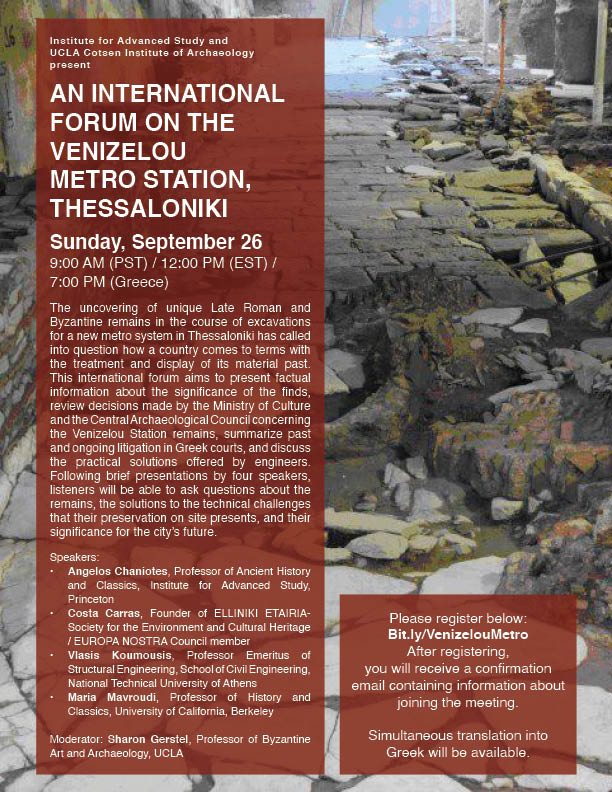
 

Call for Papers : International Conference of the Volos Academy on St. Symeon the New Theologian

« On the occasion of the millinery anniversary of the dormition of St. Symeon, the New Theologian (1022-2022), the Volos Academy for Theological Studies organizes an international conference to commemorate his personality, thought, and contribution to Orthodox theology and spirituality, which will take place in Volos, Greece, in a physical form, from 26 to 29 May 2022, in compliance with all the enforced by the European and state sanitary measures.

This conference aims to bring together scholars who have made important contributions to the study of the work of St. Symeon the New Theologian and its reception from the philosophical, historical, philological and theological points of view. The following statement offers some possible topics but does not intend to exclude alternative issues:

The renewed interest in the study of the work and the thought of St. Symeon during the last decades has highlighted a number of both timeless and topical issues concerning, one way or another, the entire Christian world. The relationship between institution and charisma or sacraments and asceticism; the understanding of faith and doctrinal teaching as the content of personal consciousness; the anthropology of deification and the emergence of the Christian subject, as well as St. Symeon’s commitment to the ecclesial body are only some of the aspects of the relevant and on-going discussion. To rearrange these issues based on the critical and prophetic character of theology demands a creative and fruitful reflection, with the self-evident inclusion of the particularities of our times, in the perspective of the authentic experience of the life in Christ in the context of our current post-modern reality.

Committed speakers include: Theophilos Ambatzidis (Volos Academy), Eirini Afentoulidou (Austrian Academy of Sciences, Vienna), Paul Argárate (Universität Graz), Sabino Chialà (Community of Bose, Italy), Marie-Hélène Congourdeau (CNRS, Paris), Barbara Crostini-Lappin (Uppsala University), Paul Gavrilyuk (Founding President of IOTA, St. Thomas University, MN, USA), Athanasios Markopoulos (University of Athens), Dimitrios Moschos (University of Athens), Dimitrios Oulis (University of Athens), Symeon Paschalidis (University of Thessaloniki), István Perczel (Central European University, Budapest/Vienna), Basilio Petrà (Facoltà teologica dell’Italia centrale, Florence), Aikaterini Tsalampouni (University of Thessaloniki), Vasilios Tsigkos (University of Thessaloniki), Stavros Yagkazoglou (University of Athens), Panayiotis Yfantis (University of Thessaloniki)

Junior and early career scholars are, therefore, invited to submit proposals for short papers (15 min.) which preferably should be related to one of the thematic axes of the conference. Provisional title, abstract (max. 350 words) and a concise CV (max. 200 words) should be submitted to Dr. Nikos Kouremenos (nkouremenos@acadimia.org) by March 4, 2022. All proposals will be evaluated by a scientific committee. The working languages of the conference are English and Greek (with a simultaneous translation to be provided). The decision of acceptance will be communicated before the 1st of April 2022. Volos Academy will provide full accommodation to all accepted speakers – unfortunately, though, travel expenses will not be covered. After the conference, presenters will be invited to rework their presentations towards the publication of the conference proceedings, which will be assessed through a peer-review procedure. »

Worth Their Weight In Gold: The Significance of Lead Seals to Byzantine Studies

Worth Their Weight In Gold: The Significance of Lead Seals to Byzantine Studies

October 28, 2021 5:00-6:30pm EDT
Virtual Public Lecture with Alicia Walker

Register

Byzantine sigillography is a specialized subdivision of an already esoteric field. Yet this seeming obscurity belies the substantial interdisciplinary value of lead seals. The iconographic, inscriptional, and functional aspects of these objects offer unique perspectives on diverse areas of interest, both within the study of Byzantine society and with respect to medieval intercultural dynamics. In this lecture, Alicia Walker presents Byzantine sigillography as a rich domain for interdisciplinary investigation and collaboration, highlighting lead seals as a nexus for exchange among the various fields of Byzantine studies and a vital conduit for contributions to medieval studies more broadly.

Alicia Walker (PhD, Harvard University) is professor of medieval art and architecture at Bryn Mawr College. Her primary fields of research are cross-cultural artistic interaction in the medieval world from the ninth to the thirteenth century and gender issues in the art and material culture of Byzantium. Her first monograph, The Emperor and the World: Exotic Elements and the Imaging of Middle Byzantine Imperial Power, Ninth to Thirteenth Centuries CE, was published by Cambridge University Press in 2012. She is coeditor of the essay collection Negotiating Secular and Sacred in Medieval Art: Christian, Islamic, and Buddhist (Ashgate, 2009), and the special issue of the journal Medieval Encounters entitled Mechanisms of Exchange: Transmission in Medieval Art and Architecture of the Mediterranean, ca. 1000–1500 (Brill, 2012, vol. 18, no. 4­–5). She is an alumna of the Dumbarton Oaks Byzantine coins and seals summer program and her research on exotic motifs in Byzantine lead seals has appeared in The Medieval History Journal.

Image: Joseph imperial spatharios and kommerkiarios, tenth century, 25 mm diam. Dumbarton Oaks, Harvard Art Museums/Arthur M. Sackler Museum, bequest of Thomas Whittemore, 1951.31.5.1778

Perspective, n° 2022-2 : Raconter

Appel à contributions :

Perspective, actualité en histoire de l’art

Raconter, n°2022–2 : Raconter

Dans son numéro 2022 – 2, la revue Perspective souhaite poser la question des relations entre narration, art et histoire de l’art. Qu’il s’agisse des récits sur lesquels se fondent les images et les objets d’art, de ceux que (se) constituent ses regardeurs, ou des «mises en récits» opérées par les historiens et les historiennes de l’art, ce numéro entend s’emparer de l’acte de raconter comme d’un outil heuristique aussi fécond que déstabilisant. L’image et l’objet d’art racontent, même en l’absence de contenu diégétique figuré, ne serait-ce qu’en tant que témoins d’une époque ou de pratiques – ne serait-ce qu’en tant que vecteurs de narrativité. Les récits visuels ainsi déployés ne cessent de générer d’autres récits – fictions ou légendes, articles scientifiques ou divagations rêveuses; dialogues d’œuvres entre elles ou soliloques des regardeurs. Récits de l’histoire de l’art, également, tant les historiens et les historiennes de l’art ne cessent de raconter ce processus tout en le constituant de manière performative, dans ses multiples emboîtements et ses allers-retours, évoluant dans ces zones mouvantes entre fait et fiction, expression et narration, description, analyse et projection.

Pour lire la suite de l’appel, et pour télécharger l’annonce, cliquer ici. 

Prière de faire parvenir vos propositions (un résumé de 2000 à 3000signes, un titre provisoire, une courte bibliographie sur le sujet, et une biographie de quelques lignes) à l’adresse de la rédaction (revue-perspective@inha.fr) avant le 1er juillet 2021.

Perspective prenant en charge les traductions, les projets seront examinés par le comité de rédaction quelle que soit la langue. Les auteurs des propositions retenues seront informés de la décision du comité de rédaction à la fin du mois de juillet 2021, tandis que les articles seront à remettre pour le 15décembre 2021.

Les articles soumis, d’une longueur finale de 25000 ou 45000 signes selon le projet envisagé, seront définitivement acceptés à l’issue d’un processus anonyme d’évaluation par les pairs.